Perfume Concentration Levels: A Buyer's Checklist for Brand Teams
Concentration is the most quoted number on a perfume brief and the least useful on its own. It sets the ratio of fragrance compound to carrier, but what a customer actually experiences - how long the scent lasts, how far it projects, how it changes on skin - depends just as much on which materials were chosen, the alcohol grade, and the format the liquid goes into. Treat concentration as one variable you specify deliberately, not as a promise the product will keep by itself.
Key takeaways
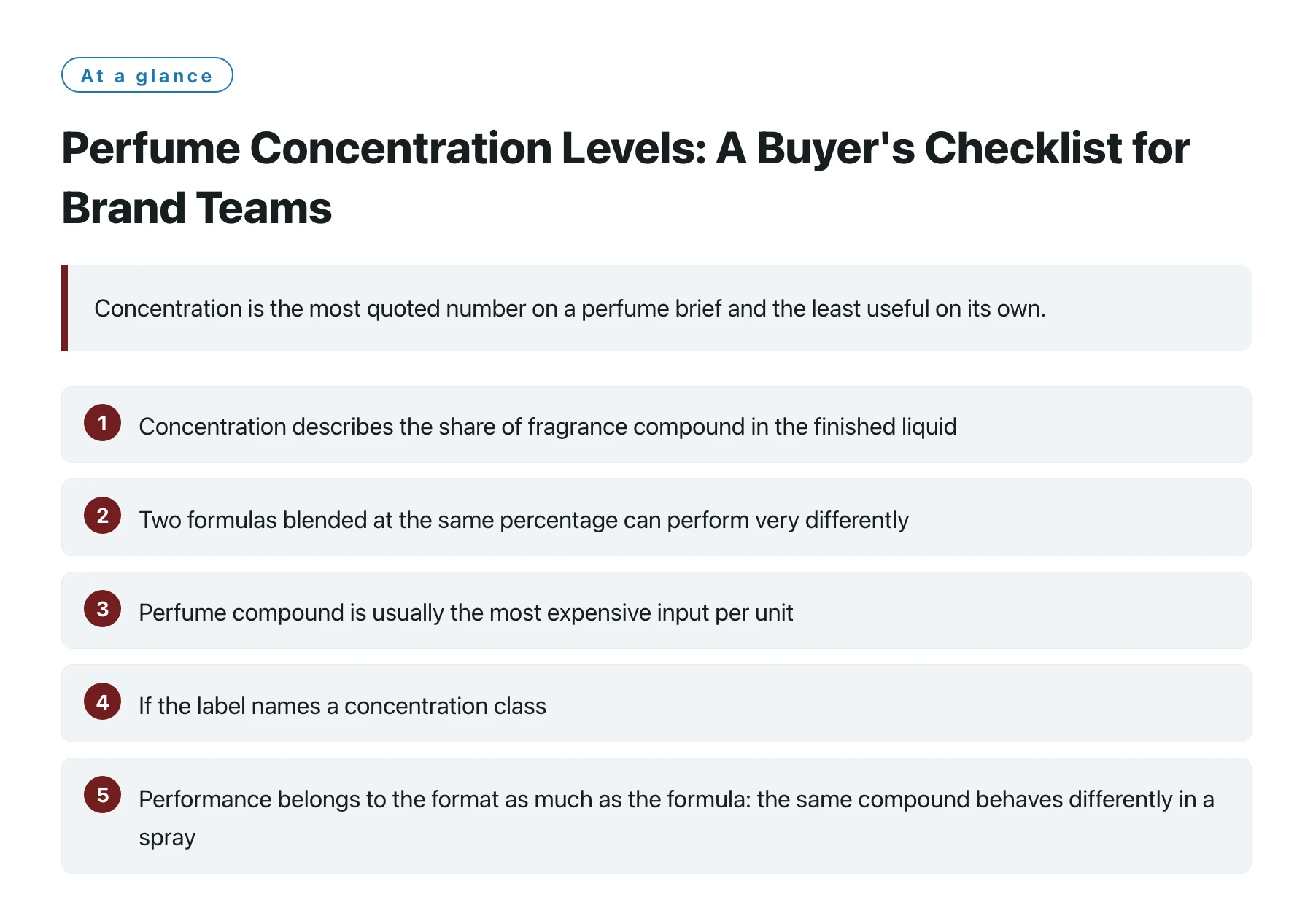
- Concentration describes the share of fragrance compound in the finished liquid; it is not a quality grade, and an eau de parfum is not automatically better than an eau de toilette.
- Two formulas blended at the same percentage can perform very differently, because diffusion and longevity come from the materials and their evaporation curves, not from the number alone.
- Perfume compound is usually the most expensive input per unit, so concentration is the first place a cost conversation should go.
- If the label names a concentration class, that claim has to stay defensible against the fill you actually produce, batch after batch.
- Performance belongs to the format as much as the formula: the same compound behaves differently in a spray, a roll-on, a body mist and a home fragrance application.
The question arrives early in almost every project, usually phrased as 'what concentration should we use?' It is a reasonable question asked in the wrong order, because the answer depends on the price ceiling, the format, the market and what the brand is willing to defend on a label.
What follows is written for a brand team that already has a product line and is adding or reworking a fragrance, rather than for a first launch. At that stage the useful work is not picking a number but understanding which decisions the number locks in.
What concentration actually controls
A fragrance is a solution: a compound of aroma materials dissolved in a carrier, most often ethanol for fine fragrance, sometimes an oil or an emulsion for other formats. Concentration is simply the proportion of that compound in the finished liquid, and it is normally expressed as a percentage on the technical sheet rather than on the label [1].
That definition sounds trivial, and it is exactly why the number gets over-read. It tells you how much aroma material is present. It does not tell you which aroma materials, how volatile they are, whether a fixative is holding the base together, or how the whole thing interacts with skin chemistry.
The ratio, and what it leaves unsaid
A perfumer builds a formula in layers: top notes that leave within minutes, a heart that carries the middle of the wear, and a base that decides how long anything remains. Concentration scales the whole structure up or down. It does not change the proportions inside it, which is why a well-built eau de toilette can outlast a poorly built extrait in everyday use.
Why the same percentage can smell stronger
Two suppliers can both quote fifteen percent and deliver very different products. One compound may lean on high-impact materials that read loudly at low dosage; another may be built from soft musks that sit close to the skin. Alcohol grade, the presence of water, and the amount of fixative all shift the release curve as well.
This is the practical reason a brand should ask for performance data rather than a concentration figure in isolation: how the sample behaves at two hours and at six hours, on skin and on a blotter, tells you more than the percentage does.
How the common classes differ in practice
| Class | Typical share of compound | Where it usually fits | What it commits the brand to |
|---|---|---|---|
| Parfum / extrait | Roughly 20-30% | A concentrated statement product, often a small flacon | The highest unit cost, and a slower, closer wear that some customers dislike |
| Eau de parfum | Roughly 15-20% | The default for a mainline fine fragrance launch | The price point most retail buyers expect, so the formula has to justify it |
| Eau de toilette | Roughly 5-15% | Lighter, more affordable, often a flanker or a summer variant | A lower cost base, and a label claim that must match the fill |
| Eau de cologne | Roughly 3-5% | Fresh, citrus-led, traditionally a splash or a large spray | Fast burn-off; the brief has to accept short wear as a feature |
| Body mist / splash | Roughly 1-3%, often with added water | Volume formats, layering products, younger price tiers | Lower cost, but a much narrower performance story |
Read the ranges as conventions rather than rules - published ranges vary between sources, and the materials inside a formula can put a hard ceiling on how much you can load in. Where a restriction applies to a specific material, the IFRA Standards set maximum use levels in the finished product, and those limits constrain the concentration ceiling for that formula [2].
The checklist to work through before the brief is frozen
The point of a checklist here is not diligence for its own sake. Each item below changes what the perfumer can do, and changing it after sampling starts means paying for samples twice.
1. Which format, exactly
A spray, a roll-on, a hair mist and a reed diffuser impose different constraints. Decide the format first, then the concentration that suits it. Understanding how fragrance concentration changes performance in a specific format is more useful than comparing classes in the abstract.
2. What the price ceiling allows
Compound cost scales with both the percentage and the materials chosen, and it is usually the largest single input in a fine fragrance bill of materials. Ask the supplier to quote the same brief at two concentration levels so the cost difference is visible before the formula is finalised.
3. What the label will claim
If the front of the pack says eau de parfum, the product has to stay inside a defensible interpretation of that class across production batches. Fill tolerance and compounding tolerance both matter here. A claim that only holds for the approved sample, and not for the bulk run, is a regulatory exposure rather than a marketing one.
4. How performance will be judged
Agree the evaluation protocol in advance: how many wearers, on skin or on blotter, at what time points, and who signs off. Without a protocol, sample review becomes a conversation about preferences, and preferences change between meetings.
5. Who owns the formula afterwards
Concentration decisions sit inside a formula, and the formula is an asset. Settle ownership and exclusivity in the same conversation, or you may find that the version you spent three rounds refining is available to another brand.
A useful habit for an established brand: keep a one-page concentration policy covering the classes you sell, the price band each one belongs in, and the performance evidence you require before approval. It shortens every future brief, and it stops the same debate recurring at each new launch.
Where concentration sits in the cost conversation
Because the compound dominates the bill of materials, concentration is the lever that moves unit cost fastest - but it is not the only one, and pulling it alone can damage the product. Reducing concentration while keeping the same materials often produces a thinner version of the same scent rather than a cheaper equivalent; reworking the formula to use lower-cost materials at a similar concentration can hold the impression together better.
This is one of the reasons it helps to work with a partner that develops and produces in one place, so the costing and the formula can be adjusted together rather than negotiated between two companies. Manufacturers set up as fine fragrance manufacturing operations usually keep a perfumer and a costing sheet near each other, which is where that trade-off gets resolved.
The other half of the answer is timing. A concentration change after bulk approval means new stability and compatibility work, a new retained sample, and often a new round of artwork. Every one of those has a cost that never appears on the unit price.
A note on samples and bulk
Concentration is also one of the reasons a sample and a bulk order can smell different. Small batches are compounded by hand and measured carefully; larger batches introduce mixing time, temperature and fill variation. If your launch depends on a precise performance impression, ask how the supplier holds the specification through scale-up, and read up on aging and dosage in custom perfume samples before you sign off the bulk.
Two questions that separate a careful supplier from a fast one
The first is what happens if the retail sample drifts from the approved standard. A careful supplier will describe the retained sample, the batch record, and the point in production where the deviation is caught. A fast one will describe goodwill.
The second is whether the supplier will tell you that your concentration target is a bad idea. If a brief asks for a very high load of a restricted material, or a very low load that will not survive the delivery format, the right answer is a documented objection, not silent compliance. A supplier that never pushes back is not necessarily agreeable; it may simply not be checking.
Sources
- Wikipedia: Perfume —— An encyclopaedic overview of perfume covering definitions, history, the note structure of a fragrance and concentration terminology (background reference only).
- IFRA Standards Library (International Fragrance Association) —— The IFRA Standards Library lists the restrictions the fragrance industry applies to individual fragrance ingredients, based on safety assessments; it is the reference point for compliant fragrance formulation.
Frequently asked questions
Is a higher concentration always better?
No. Higher loading changes how a scent unfolds and can make some materials read harshly, and it raises unit cost. The right level depends on the format, the materials and the price point the product has to hit.
Can we use the same formula at two concentrations for two price tiers?
Sometimes, but it is rarely as simple as diluting. Reducing the load changes the balance between top, heart and base, so the cheaper version usually needs its own adjustment to keep the same character.
How do we know the concentration on our label is defensible?
Keep the approved formula, the fill specification and the batch records aligned, and make sure the compounding tolerance in the specification is tight enough that every production run stays inside the class you claim.
Does concentration determine how long a fragrance lasts?
It contributes, but it is not the deciding factor. Material selection, fixatives, the carrier and the substrate the fragrance sits on all shape longevity, which is why wear testing matters more than the percentage on the sheet.
When should we finalise concentration in the development timeline?
Before stability and compatibility testing begins in earnest. Changing it afterwards restarts part of that testing and can push packaging artwork and regulatory documentation back with it.