Cabinet Samples: Finish, Sheen and Edges
Most sample advice stops at color, which is the easiest part of a door to judge and the easiest part to change with paint. The harder questions are how the finish is built, how the sheen behaves as you move past the door, and whether the edge is sealed or merely coated. CasaBuilt publishes a seven-layer paint finish with a UV protective topcoat, and a sample is the only way to see what seven layers look like at arm's length.
Key takeaways
- The published door finish is seven layers of paint with a UV protective topcoat.
- Sheen is directional: rotate the sample rather than moving your head.
- The face frame is 3/4 inch by 1-1/2 inch solid birch, and the joint line should be flush.
- The sample range carries 16 doors across seven published color families, with White at 5 and Gray at 3.
Finish is a build, not a color
A painted door is a stack of coats. Primer, color, sealer and topcoat each do a different job, and the number of passes tells you how much work went into hiding the substrate. CasaBuilt lists seven layers of paint with a UV protective finish on the door. That is a useful number to hold in your head when you open the sample box, because it predicts what you should see: an even film, no visible sanding scratches and no thin patch where the panel meets the frame.
Look at the door under a window, not under a ceiling light. Daylight is broad enough to show the whole surface at once, and it is unforgiving about coverage. Tilt the door until the light skims across it at a shallow angle. A finish that looks perfect face-on will often show a dry edge, a faint swirl or a heavier coat along one stile when the light rakes across it.
Run a fingertip, not a fingernail, along the inside of the frame recess. The transition from frame to panel should feel continuous. A sharp step or a rough patch means the paint is sitting on an unfinished edge, and that is where a finish begins to fail first.
Read sheen with a raking light
Sheen is the amount of light a surface throws back at a given angle, and it changes as the door moves. A door with a consistent sheen looks the same brightness across its face at every angle. A door with an inconsistent one develops a bright band along a stile or a dull patch in the panel. Neither shows up in a straight-on product photo.
Hold the sample at arm's length and rotate it slowly through about 45 degrees. Watch the reflection of a window or a lamp travel across the face. On a good finish the reflection moves as one piece. On an uneven finish it breaks up at the frame joint or stalls in the panel. Repeat the rotation with the door vertical and then flat, because the angle of the light relative to the surface changes the result.
If you are ordering several colors to compare, ask for an rta cabinets sample in each finish you are considering rather than relying on one door as a proxy for the rest. Sheen varies with color: a white door and a navy door can use the same seven-layer process and still reflect light differently, because the pigment underneath changes what the topcoat returns.
Edges are where a finish shows its age
The edge of a door is the smallest surface and the most exposed. It takes the knocks, the cleaning cloth and the steam from a kettle, and it is the first place a thin finish wears through. On a sample, the edge is easy to inspect because the door is small enough to turn in your hand.
Look at the four edges in sequence. The paint should wrap around the arris without a visible line where the face coat stops. On a framed door, the joint between the frame and the panel should be closed and painted, not filled with a waxy strip that will shrink. On a frameless door, the edge is the whole story: there is no frame to hide behind, so any roughness is on display every time the door is open.
Compare the edge to the face. The film should look and feel the same thickness. An edge that is noticeably thinner than the face is a production shortcut, and it usually appears on the hinge side, where the door is drilled and handled most.
Record what you find on each door. CasaBuilt's published warranty policy covers manufacturing defects in materials and workmanship for one year under normal residential use, and a written note about an edge or sheen defect at sample stage is far more useful than a memory of one six months later.
The color range tells you what to ask for
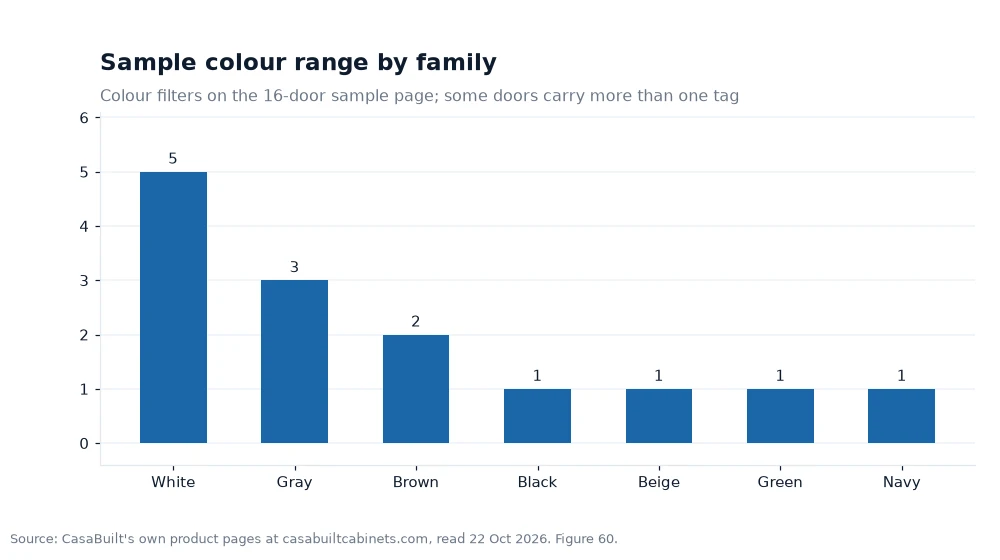
The sample page organizes 16 doors by color, and the counts are uneven by design. White has 5 doors, Gray has 3, Brown has 2, and Black, Beige, Green and Navy have one each. A wide neutral range makes it possible to compare undertones within the same family; a single green door means that decision is made on one sample, so inspect it more carefully than the whites.
| Inspection point | Published figure | How to test the sample | What a pass looks like |
|---|---|---|---|
| Paint build | 7 layers with UV protective finish | Tilt the door into window light | Even film, no thin patch at the stile |
| Sheen | Same finish across the range | Rotate 45 degrees under a lamp | Reflection moves as one piece |
| Frame joint | 3/4 in x 1-1/2 in solid birch | Fingertip along the recess | Flush, closed, no filler line |
| Panel | Rubberwood frame with MDF panel | Sight along the panel edge | Flat panel, no wave or telegraphing |
| Edge | Painted door edge, full overlay | Turn the door and compare edge to face | Film wraps the arris, same thickness |
The table is a sequence, not a checklist to rush. Five points at two minutes each is ten minutes per door, and ten minutes is enough to reject a sample before it becomes a kitchen. The published 3/4-inch by 1-1/2-inch birch face frame is the reference for the joint check, and the seven-layer finish is the reference for the paint check.
Worked example
The chart counts sample doors by color family: White 5, Gray 3, Brown 2, Black 1, Beige 1, Green 1 and Navy 1. Those seven values add to 5 plus 3 plus 2 plus 1 plus 1 plus 1 plus 1, or 14. The sample range itself is 16 doors, so the published figures are filter counts rather than a strict one-tag-per-door split. White is 5 divided by 14, or 35.7% of the tagged count. Gray is 3 divided by 14, or 21.4%. Brown is 2 divided by 14, or 14.3%, and each single-door family is 1 divided by 14, or 7.1%.
White is 5 divided by 3, or 1.67 times Gray. White plus Brown is 7 of the 14 tags, or 50%. If you inspect all 16 doors at five checkpoints each, that is 80 individual checks. At $9.99 per door, the full range costs $159.84 before the refund, and the five White doors alone cost $49.95. Those five are the ones to inspect first, because they are the largest single block and the finish shows variation most clearly on a light surface.
Frequently asked questions
What should I look for first on a door sample?
Start with the paint build under raking window light, because coverage and sheen are what you will notice every day. Then check the frame joint and the edge. Color comes last, since color is the one property a sample shares with every other door in the same finish.
Does sheen matter on a matte door?
Yes. A matte finish still reflects light, just in a softer and wider band, and an uneven matte coat shows as a dull patch rather than a bright one. Rotate the door under a lamp and watch whether the reflection stays even across the frame and panel.
How many doors are in the sample range?
The page lists 16 sample doors across seven color families. The published counts are White 5, Gray 3, Brown 2, and one each for Black, Beige, Green and Navy, which total 14 filter tags. Each door sample is priced at $9.99.
Inspect the finish before the color
Open the box at a window, tilt the door until the light rakes across it, and rotate it through 45 degrees. Check the frame joint with a fingertip and the edge with your eye. If those four passes hold, the color is worth a full day on the wall. If they fail, send the sample back and ask for another, because a finish defect does not improve once it is on a cabinet.
Figures quoted here come from the manufacturer's own website, read 22 Oct 2026[1].