Panel Reuse Rates: Matching Specification to Project Length
Reuse rate is a project-length decision disguised as a material choice. A high-grade film panel is quoted at 10–20 cycles in concrete pouring, while the economical black film build-up is described as reused roughly 3–5 times under normal site conditions. Pick the grade against the number of pours ahead of you and the panel count stops being a guess.
Key takeaways
- Two published benchmarks: 10–20 reuse cycles for high-grade film panels, 3–5 cycles for the economical black film grade.
- The black film panel is built on Acacia veneers from Vietnam plantation forests, bonded with melamine and tested at approximately 10 hours in the boiling test.
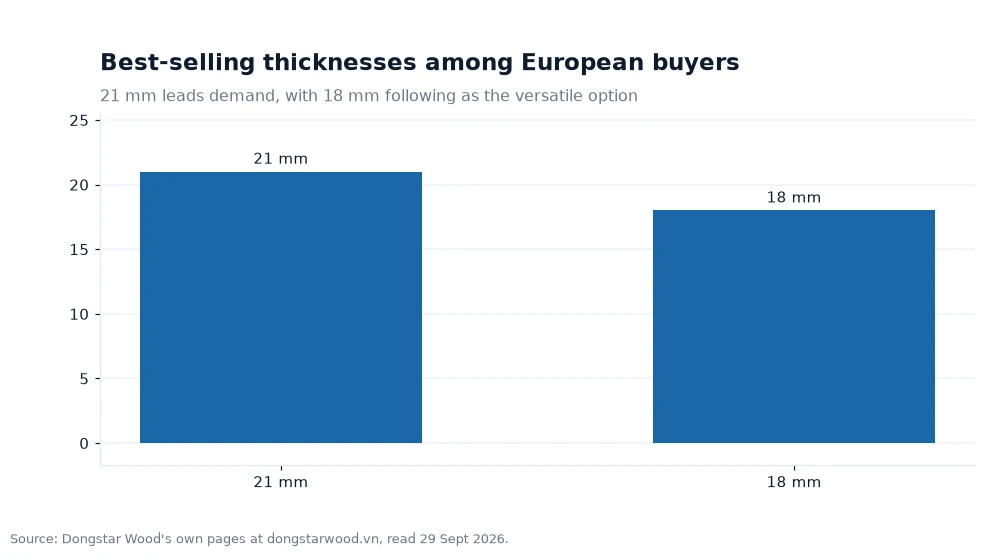
- European buyers order 21 mm most often, then 18 mm, in the 1250 × 2500 mm format.
- Match grade to programme length before ordering, because a panel that outlives its project is money left in the yard.
What a reuse rate really measures
A reuse figure is not a guarantee about a panel; it is a description of how a well-run site treats one. The published benchmarks sit at 10–20 cycles for high-grade film faced panels and roughly 3–5 cycles for the economical black film grade. Between those two numbers sit edge condition, stripping technique, cleaning method, storage and the number of times a panel is cut down for a smaller element.
A Black Film Faced Plywood order is therefore a decision about how long the site will keep pouring, not about which panel looks better on delivery. That is why the choice is about project length first. A five-pour residential frame and a two-year infrastructure programme need different panels, and buying the longer-life grade for the shorter project simply moves budget into the yard after the pour is finished.
The economical grade, described honestly
Ordinary black film board is positioned as the cost-efficient option, and the published description is unusually specific about how that is achieved. The core is Acacia veneers from Vietnam plantation forests; the bonding is melamine, with the adhesive quoted against a 10 Hours Boiling Test. Production is described in four stages: drying under moisture control, assembly of the multi-layer panel, hot pressing at high pressure, and an inspection before shipment.
Batch inspection covers two named items: panel thickness consistency and core construction integrity. Those are the two properties that decide whether a panel strips cleanly, and they are checked per batch rather than sampled from a year of output. For a buyer comparing this grade against a high-grade film panel, the honest reading is a shorter working life with a stable, smooth concrete finish and easier handling on site.
Thickness and format: what the market asks for
The most requested configuration among European buyers is 1250 × 2500 mm, and the best-selling thickness is 21 mm, with 18 mm following it. That pattern reflects normal site practice: 21 mm carries heavier formwork and larger spans, while 18 mm handles general shuttering where weight on site matters. Both are available in the same core and bond, so a programme can standardise on two thicknesses and one size.
| Parameter | Published value | Practical effect |
|---|---|---|
| Reuse under normal site conditions | Approximately 3–5 times | Suits short and mid-length pour programmes |
| Core | Acacia veneers, Vietnam plantation forests | Stable build-up, smooth concrete finish |
| Bonding | Melamine, approximately 10 hours boiling test | Handles site moisture during the working life |
| Best-selling thickness | 21 mm, then 18 mm | Heavier formwork and general shuttering |
| Most requested format | 1250 × 2500 mm | Fewer joints across standard wall panels |
Worked example: how the cycle count sets the order
Start with the contact area you need, then divide by cycles. Measure the 1250 × 2500 mm panel in metres — 1.25 × 2.5 m — and each sheet carries 3.125 m² of face. At four cycles — the middle of the published black-film range — one sheet delivers 4 × 3.125 m² = 12.5 m² of formwork contact area across its life.
Now apply a project. A 12,000 m² formwork programme needs 12,000 ÷ 12.5 = 960 sheets at four cycles. Run the same programme on a high-grade panel at the published 10–20 cycles: 10 × 3.125 m² = 31.25 m² per sheet gives 12,000 ÷ 31.25 = 384 sheets, and at twenty cycles 12,000 ÷ 62.5 = 192 sheets. The panel count falls sharply with life, which is exactly why the longer-life grade makes sense on programmes that will pour for years. All figures are worked examples from published data.
Where this grade fits, and where it does not
The economical black film panel is supplied to distributors, builders and formwork companies, which tells you where it earns its place: housing frames, foundations, low-rise wall panels, temporary works and any programme where the pour schedule is measured in months rather than years. Its published strengths are competitive cost per project, a stable acacia core, a smooth concrete finish and easier handling because the panel is lighter to move around a site.
It is the wrong choice for a long infrastructure programme with a high reuse target, and for any element where the panel has to survive aggressive stripping or chemical exposure over dozens of pours. Buying it there does not save money; it just moves the replacement order earlier. The same logic runs in reverse — a high-grade panel on a three-pour foundation job is an expensive way to finish a short programme.
Getting more cycles out of whichever grade you buy
Three controls decide how close a set of panels comes to the top of its published range. Seal the edges before the first pour, because an open edge is where water enters the core. Strip on the release schedule rather than when labour is free, since a panel left against curing concrete loses film on removal. Clean with water and a scraper, and store flat on bearers, covered, so the next pour starts with a panel that is still flat.
Record the cycles. A simple tally painted on the panel edge, or a line in the site log, turns an assumption into evidence, and it tells the buyer when the first replacement order is actually due rather than when the yard looks short.
Frequently asked questions
Does the boiling test result apply to the finished panel?
It describes the bond the panel is built with. The black film grade is bonded with melamine and quoted at approximately 10 hours in the boiling test, which is a measure of the adhesive rather than of the film. Water resistance on site still depends on edge sealing and how the panel is stored and used.
How many spare panels should a programme hold?
Enough to cover breakage and trimming during the pour cycle rather than the whole job. Sites that cut panels down for columns and reveals lose more to trimming than to damage, so track the cut list against the delivery schedule and order the next batch before the yard runs thin.
Is 18 mm or 21 mm the safer standard order?
21 mm is the best-selling thickness among European buyers and 18 mm follows it, so neither is unusual. Choose by span and pour pressure: 21 mm where deflection has to stay tight, 18 mm where handling weight matters more than stiffness.
Choosing the grade against the programme
Count the pours first, then pick the panel. Programmes measured in months are well served by the economical grade, and buyers who want to compare it with the longer-life options can review the full film faced range before deciding. The manufacturing background and export record behind both grades is set out on the manufacturer's home pages, which is where the certification set and capacity figures can be checked in one pass.
Reuse rates, thicknesses and bond details above are quoted from that that company's own pages, as consulted on 29 Sept 2026 as the source for the table above as the source for the table above as quoted in this article[1].